Saturday, March 2, 2013

MASAI MARA GAMES RESERVE, MASAI, KENYA

THE MASAI MARA PEOPLE
Masai Men on the Masai Beach
The Maasai are a Nilotic group inhabiting the African Great Lakes region. Nilotes speak Nilo-Saharan language, and came to Eastern Africa by way of South Sudan. Most Nilotes in the area, including the Maasai, the Samburu and the Kalenjin, are pastoralists, and are famous for their fearsome reputations as warriors and cattle-rustlers. As with the Bantu, the Maasai and other Nilotes in Eastern Africa have adopted many customs and practices from the neighboring Cushitic groups, including the age set system of social organization, circumcision, and vocabulary terms. The Maasai people of East Africa live in southern Kenya and northern Tanzania along the Great Rift Valley on semi-arid and arid lands. The Maasai occupy a total land area of 160,000 square kilometers with a population of approximately one half million people. However, many Maasai see the national census as government meddling and often miscount their numbers to census takers.

According to their own oral history, the Maasai originated from the lower Nile valley north of Lake Turkana (Northwest Kenya) and began migrating south around the 15th century, arriving in a long trunk of land stretching from what is now northern Kenya to what is now central Tanzania between the 17th and late 18th century. Many ethnic groups that had already formed settlements in the region were forcibly displaced by the incoming Maasai, while other, mainly southern Cushitic groups, were assimilated into Maasai society. The resulting mixture of Nilotic and Cushitic populations also produced the Kalenjin and Samburu.

Sunset at the Masai Mara National Reserve
The Maasai territory reached its largest size in the mid-19th century, and covered almost all of the Great Rift Valley and adjacent lands from Mount Marsabit in the north to Dodoma in the south. At this time the Maasai, as well as the larger Nilotic group they were part of, raised cattle as far east as the Tanga coast in Tanganyika (now mainland Tanzania). Raiders used spears and shields, but were most feared for throwing clubs (orinka) which could be accurately thrown from up to 70 paces (appx. 100 metres). In 1852, there was a report of a concentration of 800 Maasai warriors on the move in what is now Kenya. In 1857, after having depopulated the "Wakuafi wilderness" in what is now southeastern Kenya, Maasai warriors threatened Mombasa on the Kenyan coast.

The Maasai society is comprised of sixteen sections (known in Maasai as Iloshon): Ildamat, Ilpurko, Ilkeekonyokie, Iloitai, Ilkaputiei, Ilkankere, Isiria, Ilmoitanik, Iloodokilani, Iloitokitoki, Ilarusa, Ilmatatapato, Ilwuasinkishu, Kore, Parakuyu, and Ilkisonko, also known as Isikirari (Tanzania's Maasai). There was also once Iltorobo section but was assimilated by other sections. A majority of the Maasai population lives in Kenya. Sections such as Isikirari, Parakuyu, Kore and Ilarusa lives in Tanganyika.
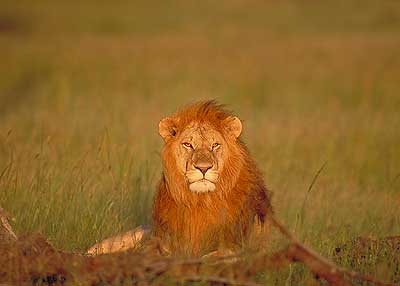
A lion at the Masai National Reserve
The Maasai live in Kraals arranged in a circular fashion. The fence around the kraal is made of acacia thorns, which prevent lions from attacking the cattle. It is a man's responsibility to fence the kraal. While women construct the houses. Traditionally, kraals are shared by an extended family. However, due to the new land management system in the Maasai region, it is not uncommon to see a kraal occupied by a single family. The Inkajijik (maasai word for a house) are loaf-shaped and made of mud, sticks, grass, cow dung and cow's urine. Women are responsible for making the houses as well as supplying water, collecting firewood, milking cattle and cooking for the family. Warriors are in charge security while boys are responsible for herding livestock. During the drought season, both warriors and boys assume the responsibility for herding livestock. The elders are directors and advisers for day-to-day activities. Every morning before livestock leave to graze, an elder who is the head of the inkang sits on his chair and announces the schedule for everyone to follow.

The Maasai are a semi-nomadic people who lived under a communal land management system. The movement of livestock is based on seasonal rotation. Contrary to many claims made by outsiders, particularly the Hardinian school of thought, this communal land management system allows us to utilize resources in a sustainable manner. Each section manages its own territory. Under normal conditions, reserve pastures are fallowed and guarded by the warriors. However, if the dry season becomes especially harsh, sections boundaries are ignored and people graze animals throughout the land until the rainy season arrives. According to Maasai traditional land agreement, no one should be denied access to natural resources such as water and land.
Tourists being entertained by a Jagu
Maasai society is strongly patriarchal in nature, with elder men, sometimes joined by retired elders, deciding most major matters for each Maasai group. A full body of oral law covers many aspects of behaviour. Formal execution is unknown, and normally payment in cattle will settle matters. An out-of-court process is also practiced called 'amitu', 'to make peace', or 'arop', which involves a substantial apology. The Maasai aremonotheistic, worshipping a single deity called Enkai or Engai. Engai has a dual nature: Engai Narok (Black God) is benevolent, and Engai Nanyokie (Red God) is vengeful. The "Mountain of God", Ol Doinyo Lengai, is located in northernmost Tanzania. The central human figure in the Maasai religious system is the laibon whose roles include shamanistic healingdivination and prophecy, and ensuring success in war or adequate rainfall. Whatever power an individual laibon had was a function of personality rather than position.  Many Maasai have become Christian, and to a lesser extent, Muslim. The Maasai are known for their intricate jewelry.

MASAI MARA NATIONAL RESERVE
The Masai Mara is one of the best known and most popular reserves in the whole of Africa. At times and in certain places it can get a little overrun with tourist minibuses, but there is something so special about it that it tempts you back time and again.

A Cheetah on display at the National Par
Seasoned safari travellers, travel writers, documentary makers and researchers often admit that the Masai Mara is one of their favourite places. So why is that? Perhaps it is because of the 'big skies', the open savannahs, the romance of films like 'Out of Africa' and certainly because of the annual wildebeest migration, the density of game, the variety of birdlife and the chance of a hot air balloon ride. Also because of the tall red-robed Masai people whose lifestyle is completely at odds with western practices, and from whom one learns to question certain western values. A combination of all these things plus something to do with the spirit of the place - which is hard to put into words - is what attracts people to the Mara over and over.

The Masai Mara lies in the Great Rift Valley, which is a fault line some 3,500 miles (5,600km) long, from Ethiopia's Red Sea through Kenya, Tanzania, Malawi and into Mozambique. Here the valley is wide and a towering escarpment can be seen in the hazy distance. Most of the game viewing activities occur on the valley floor, but some lodges conduct walking tours outside the park boundaries in the hills of the Oloololo Escarpment. The animals are also at liberty to move outside the park into huge areas known as 'dispersal areas'. There can be as much wildlife roaming outside the park as inside. Many Masai villages are located in the 'dispersal areas' and they have, over centuries, developed a synergetic relationship with the wildlife. There are four main types of topography in the Mara: Ngama Hills to the east with sandy soil and leafy bushes liked by black rhino; Oloololo Escarpment forming the western boundary and rising to a magnificent plateau; Mara Triangle bordering the Mara River with lush grassland and acacia woodlands supporting masses of game especially migrating wildebeest; Central Plains forming the largest part of the reserve, with scattered bushes and boulders on rolling grasslands favoured by the plains game.

ANIMALS & BIRDS
In a short stay during the wildebeest migration you could see thousands of animals, at other times there are still hundreds. The plains are full of wildebeest, zebra, impala, topi, giraffe, Thomson's gazelle. Also regularly seen are leopards, lions, hyenas, cheetah, jackal and bat-eared foxes. Black rhino are a little shy and hard to spot but are often seen at a distance.

Wild beast migrating
Hippos are abundant in the Mara River as are very large Nile crocodiles, who lay in wait for a meal as the wildebeest cross on their annual quest to find new pasturesEvery July (or sometimes August), the wildbeast travel over 600 miles (960km) from Tanzania's Serengeti plains, northwards to the Masai Mara and the Mara River is the final obstacle. In October or November, once they have feasted and the grass has all but gone, they turn around and go back the other way. The Mara birds come in every size and colour including common but beautiful ones like the lilac breasted roller and plenty of large species like eagles, vultures and storks. There are 53 different birds of prey.

SEASONS
Altitude is 4,875-7,052 feet (1,500-2,170 metres) above sea level, which yields a climate somewhat milder and damper than other regions. The daytime rarely exceeds 85°F (30°C) during the day and hardly ever drops below 60°F (15°C) at night.

Rainy Season: It rains in April and May and again November and this can cause some areas of the Mara to be inaccessible due to the sticky 'black cotton' mud. 

Dry Season: July to October is dry and the grass is long and lush after the rains. This is a good time to come and see the huge herds of migratory herbivores.
 
Hottest time: The warmest time of year is December and January.
Coldest Time: June and July are the coldest months.

MASAI MARA SPECIALITIES
Masai tribal men
· Wild-beast Migration
· Hot Air Ballooning
· Huge savannahs of golden grasslands
· Big skies
· Rift Valley escarpment

· Lion sightings

FACTS
This is a malarial area
The reserve covers an area of 1,510 km²
There is no night driving and vehicles must be back at the lodge by 6pm.
Several lodges are located outside the park's boundaries, but as there are few fences you may not be aware of this.
This is a Reserve rather than a National Park and it belongs to the Masai people.

ACCOMMODATION


VISIT KENYA: SEE MASAI MARA NATIONAL RESERVE

THE MASAI MARA PEOPLE

The Maasai are a Nilotic group inhabiting the African Great Lakes region. Nilotes speak Nilo-Saharan language, and came to Eastern Africa by way ofSouth Sudan. Most Nilotes in the area, including the Maasai, the Samburu and the Kalenjin, are pastoralists, and are famous for their fearsome reputations as warriors and cattle-rustlers. As with the Bantu, the Maasai and other Nilotes in Eastern Africa have adopted many customs and practices from the neighboring Cushitic groups, including the age set system of social organization, circumcision, and vocabulary terms.

Sunset at the Masai Mara National Reserve
The Maasai people of East Africa live in southern Kenya and northern Tanzania along the Great Rift Valley on semi-arid and arid lands. The Maasai occupy a total land area of 160,000 square kilometers with a population of approximately one half million people. However, many Maasai see the national census as government meddling and often miscount their numbers to census takers.

According to their own oral history, the Maasai originated from the lower Nile valley north of Lake Turkana (Northwest Kenya) and began migrating south around the 15th century, arriving in a long trunk of land stretching from what is now northern Kenya to what is now central Tanzania between the 17th and late 18th century. Many ethnic groups that had already formed settlements in the region were forcibly displaced by the incoming Maasai, while other, mainly southern Cushitic groups, were assimilated into Maasai society. The resulting mixture of Nilotic and Cushitic populations also produced the Kalenjin and Samburu.

Masai tribal m
The Maasai territory reached its largest size in the mid-19th century, and covered almost all of the Great Rift Valley and adjacent lands from Mount Marsabit in the north to Dodoma in the south. At this time the Maasai, as well as the larger Nilotic group they were part of, raised cattle as far east as the Tanga coast in Tanganyika (now mainland Tanzania). Raiders used spears and shields, but were most feared for throwing clubs (orinka) which could be accurately thrown from up to 70 paces (appx. 100 metres). In 1852, there was a report of a concentration of 800 Maasai warriors on the move in what is now Kenya. In 1857, after having depopulated the "Wakuafi wilderness" in what is now southeastern Kenya, Maasai warriors threatened Mombasa on the Kenyan coast.

The Maasai society is comprised of sixteen sections (known in Maasai as Iloshon): Ildamat, Ilpurko, Ilkeekonyokie, Iloitai, Ilkaputiei, Ilkankere, Isiria, Ilmoitanik, Iloodokilani, Iloitokitoki, Ilarusa, Ilmatatapato, Ilwuasinkishu, Kore, Parakuyu, and Ilkisonko, also known as Isikirari (Tanzania's Maasai). There was also once Iltorobo section but was assimilated by other sections. A majority of the Maasai population lives in Kenya. Sections such as Isikirari, Parakuyu, Kore and Ilarusa lives in Tanganyika.


A lion at the Masai National Reserve
The Maasai live in Kraals arranged in a circular fashion. The fence around the kraal is made of acacia thorns, which prevent lions from attacking the cattle. It is a man's responsibility to fence the kraal. While women construct the houses. Traditionally, kraals are shared by an extended family. However, due to the new land management system in the Maasai region, it is not uncommon to see a kraal occupied by a single family.

The Inkajijik (maasai word for a house) are loaf-shaped and made of mud, sticks, grass, cow dung and cow's urine. Women are responsible for making the houses as well as supplying water, collecting firewood, milking cattle and cooking for the family. Warriors are in charge security while boys are responsible for herding livestock. During the drought season, both warriors and boys assume the responsibility for herding livestock. The elders are directors and advisors for day-to-day activities. Every morning before livestock leave to graze, an elder who is the head of the inkang sits on his chair and announces the schedule for everyone to follow.

Zebras at the National Reserve
The Maasai are a semi-nomadic people who lived under a communal land management system. The movement of livestock is based on seasonal rotation. Contrary to many claims made by outsiders, particularly the Hardinian school of thought, this communal land management system allows us to utilize resources in a sustainable manner. Each section manages its own territory. Under normal conditions, reserve pastures are fallowed and guarded by the warriors. However, if the dry season becomes especially harsh, sections boundaries are ignored and people graze animals throughout the land until the rainy season arrives. According to Maasai traditional land agreement, no one should be denied access to natural resources such as water and land.

Maasai society is strongly patriarchal in nature, with elder men, sometimes joined by retired elders, deciding most major matters for each Maasai group. A full body of oral law covers many aspects of behaviour. Formal execution is unknown, and normally payment in cattle will settle matters. An out-of-court process is also practiced called 'amitu', 'to make peace', or 'arop', which involves a substantial apology. The Maasai aremonotheistic, worshipping a single deity called Enkai or Engai. Engai has a dual nature: Engai Narok (Black God) is benevolent, and Engai Nanyokie (Red God) is vengeful. The "Mountain of God", Ol Doinyo Lengai, is located in northernmost Tanzania. The central human figure in the Maasai religious system is the laibon whose roles include shamanistic healingdivination and prophecy, and ensuring success in war or adequate rainfall. Whatever power an individual laibon had was a function of personality rather than position.  Many Maasai have become Christian, and to a lesser extent, Muslim. The Maasai are known for their intricate jewelry.

MASAI MARA NATIONAL RESERVE
The Masai Mara is one of the best known and most popular reserves in the whole of Africa. At times and in certain places it can get a little overrun with tourist minibuses, but there is something so special about it that it tempts you back time and again.
Tourists being entertained by a Jaguar

Seasoned safari travellers, travel writers, documentary makers and researchers often admit that the Masai Mara is one of their favourite places. So why is that? Perhaps it is because of the 'big skies', the open savannahs, the romance of films like 'Out of Africa' and certainly because of the annual wildebeest migration, the density of game, the variety of birdlife and the chance of a hot air balloon ride.


Also because of the tall red-robed Masai people whose lifestyle is completely at odds with western practices, and from whom one learns to question certain western values.
A combination of all these things plus something to do with the spirit of the place - which is hard to put into words - is what attracts people to the Mara over and over.

The Masai Mara lies in the Great Rift Valley, which is a fault line some 3,500 miles (5,600km) long, from Ethiopia's Red Sea through Kenya, Tanzania, Malawi and into Mozambique. Here the valley is wide and a towering escarpment can be seen in the hazy distance. Most of the game viewing activities occur on the valley floor, but some lodges conduct walking tours outside the park boundaries in the hills of the Oloololo Escarpment. The animals are also at liberty to move outside the park into huge areas known as 'dispersal areas'. There can be as much wildlife roaming outside the park as inside. Many Masai villages are located in the 'dispersal areas' and they have, over centuries, developed a synergetic relationship with the wildlife.

There are four main types of topography in the Mara: Ngama Hills to the east with sandy soil and leafy bushes liked by black rhino; Oloololo Escarpment forming the western boundary and rising to a magnificent plateau; Mara Triangle bordering the Mara River with lush grassland and acacia woodlands supporting masses of game especially migrating wildebeest; Central Plains forming the largest part of the reserve, with scattered bushes and boulders on rolling grasslands favoured by the plains game.

ANIMALS & BIRDS
In a short stay during the wildebeest migration you could see thousands of animals, at other times there are still hundreds. The plains are full of wildebeest, zebra, impala, topi, giraffe, Thomson's gazelle. Also regularly seen are leopards, lions, hyenas, cheetah, jackal and bat-eared foxes. Black rhino are a little shy and hard to spot but are often seen at a distance.

A Cheetah on display at the National Park
Hippos are abundant in the Mara River as are very large Nile crocodiles, who lay in wait for a meal as the wildebeest cross on their annual quest to find new pastures.

Every July (or sometimes August), the wildebeest travel over 600 miles (960km) from Tanzania's Serengeti plains, northwards to the Masai Mara and the Mara River is the final obstacle. In October or November, once they have feasted and the grass has all but gone, they turn around and go back the other way.

The Mara birds come in every size and colour including common but beautiful ones like the lilac breasted roller and plenty of large species like eagles, vultures and storks. There are 53 different birds of prey.

SEASONS
Altitude is 4,875-7,052 feet (1,500-2,170 metres) above sea level, which yields a climate somewhat milder and damper than other regions. The daytime rarely exceeds 85°F (30°C) during the day and hardly ever drops below 60°F (15°C) at night.

Rainy Season: It rains in April and May and again November and this can cause some areas of the Mara to be inaccessible due to the sticky 'black cotton' mud. 

Dry Season: July to October is dry and the grass is long and lush after the rains. This is a good time to come and see the huge herds of migratory herbivores.
 
Hottest time: The warmest time of year is December and January.

Coldest Time: June and July are the coldest months.

MASAI MARA SPECIALITIES
· Wildebeest Migration
· Hot Air Ballooning
· Huge savannahs of golden grasslands
· Big skies
· Rift Valley escarpment
· Lion sightings


FACTS
This is a malarial area
The reserve covers an area of 1,510 km²
There is no night driving and vehicles must be back at the lodge by 6pm.
Several lodges are located outside the park's boundaries, but as there are few fences you may not be aware of this.
This is a Reserve rather than a National Park and it belongs to the Masai people.

ACCOMMODATION

OLUMO ROCK, ABEOKUTA, NIGERIA

OLUMO ROCK AND THE EGBA PEOPLE
There is no way the history of Abeokuta will be told without the mention of Olumo Rock. You will find out why this is as you read on.  

Olumo Rock is one of the most popular tourist destinations in Nigeria. The rock sits in the city center of Abeokuta (meaning "Under the Rock") which was originally inhabited by the Egba people who found refuge at the Olumo Rock during the inter-tribal wars of the 19th century. The rock provided sanctuary to the Egba people as well as a vantage point to monitor the enemy's advance leading to eventual victories in war. Abeokuta eventually grew as new settlers spread out from this location.

Olumo Rock, Abeokuta, Nigeria
Abeokuta is just a 1-hour drive from the nations commercial capital, Lagos. Thus, providing convenient access to an array of first-class hotels, restaurants, clubs, casinos and various nightlife activities. Lagos is also home to the country's aviation hub, the Murtala Muhammed International Airport which is the closest airport to Abeokuta. Among numerous hotels within minutes of driving from the Olumo Rock are the state-owned Gateway Hotel, Dusmar Presidential Hotel, Crown Royal Hotel, Swiss International Hotel, Continental Suites, Daktad Hotel, and Supreme Hotel among others.

Tourists on Olumo Rock
Tourists to Africa definitely need to consider putting a visit to Olumo Rock on their travel plans. Infrastructures at the Olumo Rock were upgraded in 2006 after the massive renovation of the tourist site. The site now has a new museum, restaurants, water fountain and an elevator that makes the climbing challenge an easy task.
  
The ancient Itoku market where local artisans and traders enjoy to haggle over the price as much as the customers like to find a bargain lies just outside the Olumo Rock premises and is a must-see. The Itoku market is the center of the indigenous Abeokuta industry of tie-and-dye, locally known as Adire. Apart from the adire, other popular items to watch out for include local beads, bracelets, sculptures and musical instruments like the Sekere and Gangan (the talking drum). 

Aerial view of Abeokuta
A trip to Olumo Rock usually starts with a climb up the man-made stairs carved into the rock. While this sounds easy enough, it leaves many breathless and ready to take a break to rest on the benches under the trees growing from the rock and enjoy some fresh and clean breeze. The journey continues with climbs on irregularly sized rocks through a narrow corridor that leads to the top of the rock. All along the way, catch sights of carvings in the rock, cowrie-studded statues and the ancient abode of the priestesses who live in huts on the rock. And yes, it is not uncommon to catch a sight of the very aged women who live there and mutter greetings or blessings as people make their way through.

It is often helpful to enlist the services of a guide who possesses vast knowledge of the history of the rock and the culture of the people. This makes for an interesting climb as every twist and turn will reveal a significant story making the visit a truly memorable one.

On the way down the rock, the sight of the Ogun River (the river from which the State -Ogun State- derived its name) running like a silver chain amidst a forest of aged red corrugated roofs bordered by thick green forests which melt into the horizon is breathtaking.

Tourists at the ancient Itoku Market 

ZULULAND, SOUTH AFRICA: REED DANCE FESTIVAL


INTRODUCING THE ZULU PEOPLE
The native Zulu Household
Of all the sub-Saharan Bantu people, the Zulus are the most well known. They arose in the late 18th century from the hundreds of small clans occupying the northern regions of kwaZulu-Natal on the eastern seaboard of South Africa. There was always a struggle between the clans for grazing rights and conflict was commonplace but took the form of shouted insults and some weapon throwing. 

This changed with Shaka, an illegitimate son of a local chief, evicted, with his mother from his own clan. Shaka was born in 1787 and grew to be strong and fearless. He changed tactics and developed the short stabbing spear. Conflicts now assumed a deadly nature and Shaka swept all before him. He was contemporaneous with Napoleon and finally conquered a far greater area. The Zulus then came in to contact with the white man and suffered reverses at his hands, firstly with the Voortrekkers and some thirty years later, against the British. At each engagement, their warriors proved to be brave soldiers.

The nation was then broken up and some Zulus assisted both the Boers and the English during the Boer War of 1899 - 1902. Promises of emancipation made to them by the British were not honoured and a growing resentment grew during the years between union (1910) and the advent of the Afrikaner Nationalists in 1948.

Zulu King
After secession from the Commonwealth in 1960, the Zulus joined with other black groups in the struggle against apartheid until the first democratic elections in 1994.

The language of the Zulu people is "isiZulu", a Bantu language; more specifically, part of the Nguni subgroup. Zulu is the most widely spoken language in South Africa, where it is an official language. More than half of the South African population are able to understand it, with over 9 million first-language and over 15 million second-language speakers. Many Zulu people also speak AfrikaansEnglishPortugueseXitsongaSesotho and others from among South Africa's 11 official languages.

A Zulu Warrior in his War Gear
Zulus wear a variety of attire, both traditional for ceremonial or culturally celebratory occasions, and modern westernised clothing for everyday use.
The women on the other hand dress differently depending on whether they are single, engaged, or married. An unmarried woman who is still eligible is proud of her body and is not ashamed of showing it. She only wears a short skirt made of grass or beaded cotton strings and spruces herself up with lots of beadwork. An engaged woman will let her traditionally short hair grow. She will cover her bosom with a decorative cloth which is done out of respect for her future relatives and to indicate that she has been spoken for. The married woman covers her body completely signalling to other men that she is taken.

THE ROYAL READ DANCE FESTIVAL
Virgin girls on parade at the Reed Dance Festival
Experience a captivating performance when you attend the Royal Reed Dance Festival in Zululand. Once a year in early September thousands of people attend the Reed Dance festival at the KwaNyokeni Palace in Nongoma which is a vibrant celebration of Zululand’s traditional culture and rich heritage. The four day event takes its name from the reeds gathered from the river beds and carried by more than 10 000 invited virgin girls to the King’s Palace. The scenic route to the festival takes you along the breathtaking lush sugar-cane belts of Durban’s North Coast, through the abounding wildlife reserves of Zululand and finally into the undulating hills and valleys silently speaking to your soul with its natural beauty.


RITE CEREMONY
The royal reed dance festival in Zululand illustrates the proud heritage of the Zulu nation and plays a huge part in the unification of the nation’s people and the king. To ensure ritual purity, only virgin girls are permitted to partake in the ceremony. There are many myths surrounding the festival, one is that if a girl is not pure her reed will break when presenting it to the King, publicly disgracing her and her community.

FLAMBOYANT EVENT

Maidens at the Reed Dance Festival
It is a distinguished honour for the girls to represent their respective families and communities throughout the KwaZulu Natal Province and is a colourful and mesmerising event. Each area’s distinctive crafts are reflected by the stunning traditional beadwork and clothing the girls are adorned in. When you attend the Royal Reed Dance Festival in Zululand you will not only encounter a dignified traditional ritual, but at the same time revel in the energetic dazzling display of the girl’s singing and dancing talents.

PRESENTING THE REED 

The procession of girls, each carrying a reed, is led by a chief princess as well as a female sibling of the Zulu King as they proceed to the Royal Palace where the king and his regiment awaits them. A reed to mark the opening of the celebration is laid before the King by the chief princess and she is also the first one to choose a reed. It is a momentous occasion as the girls line up before the King to choose a reed and a dramatic silence hangs in the air to see whether a reed will break as each one takes a turn. The proceedings are followed by jubilant singing and dancing and to express his gratitude the King responds by performing a sacrifice to the royal ancestors on behalf of the young women and their communities. Attending the Royal Reed Dance Festival in Zululand is definitely an event not to be missed.

RECOMMENDED ITINERARY
Day 1: 
Maidens participating in the Reed Dance Event
Depart from the City of Durban along the picturesque KwaZulu Natal North Coast to Zululand. Explore the spectacular indigenous forest at Dlinza Forest Aerial Boardwalk which nestles within an urban setting. On the same route visit the Zululand Historical Museum at Fort Nongqayi and the Vukani Zulu art collection. Enjoy a light lunch at Adams Outpost and thereafter visit Martyr’s Cross not only for its historical interest but for the awesome uninterrupted views of the coastline. End the day by having dinner at Lake St Lucia abroad a float.

Day 2: 
Visit a Zulu cultural village to experience their way of life or stand in awe at the skill displayed by the spear throwers at a traditional homestead. Enjoy lunch at Eshowe whilst taking delight in the vibrant dancing and signing of the local people. Spend a night in St Lucia village where you can feast on delectable South African cuisine at a local venue.

Day 3: 
Cruise on Lake St Lucia, a wonderful ecological treasure, view the abounding wild and birdlife. The lake is home to the majestic Nile crocodile and large numbers of hippo. Relax and take in the tranquil surroundings whilst the fish eagles’ haunting cries reminds you of their presence.

ACCOMMODATION


Acknowledgement: WikipediaZulu Culture and Durban Direct

Friday, March 1, 2013

ROYAL REED DANCE FESTIVAL, ZULULAND, SOUTH AFRICA

INTRODUCING THE ZULU PEOPLE
The native Zulu Household
Of all the sub-Saharan Bantu people, the Zulus are the most well known. They arose in the late 18th century from the hundreds of small clans occupying the northern regions of kwaZulu-Natal on the eastern seaboard of South Africa. There was always a struggle between the clans for grazing rights and conflict was commonplace but took the form of shouted insults and some weapon throwing. 

This changed with Shaka, an illegitimate son of a local chief, evicted, with his mother from his own clan. Shaka was born in 1787 and grew to be strong and fearless. He changed tactics and developed the short stabbing spear. Conflicts now assumed a deadly nature and Shaka swept all before him. He was contemporaneous with Napoleon and finally conquered a far greater area. The Zulus then came in to contact with the white man and suffered reverses at his hands, firstly with the Voortrekkers and some thirty years later, against the British. At each engagement, their warriors proved to be brave soldiers.

Zulu King
The nation was then broken up and some Zulus assisted both the Boers and the English during the Boer War of 1899 - 1902. Promises of emancipation made to them by the British were not honoured and a growing resentment grew during the years between union (1910) and the advent of the Afrikaner Nationalists in 1948.

After secession from the Commonwealth in 1960, the Zulus joined with other black groups in the struggle against apartheid until the first democratic elections in 1994.

The language of the Zulu people is "isiZulu", a Bantu language; more specifically, part of the Nguni subgroup. Zulu is the most widely spoken language in South Africa, where it is an official language. More than half of the South African population are able to understand it, with over 9 million first-language and over 15 million second-language speakers. Many Zulu people also speak AfrikaansEnglishPortugueseXitsongaSesotho and others from among South Africa's 11 official languages.
A Zulu Warrior in his War Gear
Zulus wear a variety of attire, both traditional for ceremonial or culturally celebratory occasions, and modern westernised clothing for everyday use. The women on the other hand dress differently depending on whether they are single, engaged, or married. An unmarried woman who is still eligible is proud of her body and is not ashamed of showing it. She only wears a short skirt made of grass or beaded cotton strings and spruces herself up with lots of beadwork. An engaged woman will let her traditionally short hair grow. She will cover her bosom with a decorative cloth which is done out of respect for her future relatives and to indicate that she has been spoken for. The married woman covers her body completely signalling to other men that she is taken.

THE ROYAL READ DANCE FESTIVAL
Virgin girls on parade at the Reed Dance Festival
Experience a captivating performance when you attend the Royal Reed Dance Festival in Zululand. Once a year in early September thousands of people attend the Reed Dance festival at the KwaNyokeni Palace in Nongoma which is a vibrant celebration of Zululand’s traditional culture and rich heritage. The four day event takes its name from the reeds gathered from the river beds and carried by more than 10 000 invited virgin girls to the King’s Palace. The scenic route to the festival takes you along the breathtaking lush sugar-cane belts of Durban’s North Coast, through the abounding wildlife reserves of Zululand and finally into the undulating hills and valleys silently speaking to your soul with its natural beauty.

RITE CEREMONY
The royal reed dance festival in Zululand illustrates the proud heritage of the Zulu nation and plays a huge part in the unification of the nation’s people and the king. To ensure ritual purity, only virgin girls are permitted to partake in the ceremony. There are many myths surrounding the festival, one is that if a girl is not pure her reed will break when presenting it to the King, publicly disgracing her and her community.


FLAMBOYANT EVENT
Maidens at the Reed Dance Festival
It is a distinguished honour for the girls to represent their respective families and communities throughout the KwaZulu Natal Province and is a colourful and mesmerising event. Each area’s distinctive crafts are reflected by the stunning traditional beadwork and clothing the girls are adorned in. When you attend the Royal Reed Dance Festival in Zululand you will not only encounter a dignified traditional ritual, but at the same time revel in the energetic dazzling display of the girl’s singing and dancing talents.

PRESENTING THE REED 
The procession of girls, each carrying a reed, is led by a chief princess as well as a female sibling of the Zulu King as they proceed to the Royal Palace where the king and his regiment awaits them. A reed to mark the opening of the celebration is laid before the King by the chief princess and she is also the first one to choose a reed. It is a momentous occasion as the girls line up before the King to choose a reed and a dramatic silence hangs in the air to see whether a reed will break as each one takes a turn. The proceedings are followed by jubilant singing and dancing and to express his gratitude the King responds by performing a sacrifice to the royal ancestors on behalf of the young women and their communities. Attending the Royal Reed Dance Festival in Zululand is definitely an event not to be missed.

RECOMMENDED ITINERARY                                          
Day 1: 
Maidens participating in the Reed Dance Event
Depart from the City of Durban along the picturesque KwaZulu Natal North Coast to Zululand. Explore the spectacular indigenous forest at Dlinza Forest Aerial Boardwalk which nestles within an urban setting. On the same route visit the Zululand Historical Museum at Fort Nongqayi and the Vukani Zulu art collection. Enjoy a light lunch at Adams Outpost and thereafter visit Martyr’s Cross not only for its historical interest but for the awesome uninterrupted views of the coastline. End the day by having dinner at Lake St Lucia abroad a float.

Day 2: 
Visit a Zulu cultural village to experience their way of life or stand in awe at the skill displayed by the spear throwers at a traditional homestead. Enjoy lunch at Eshowe whilst taking delight in the vibrant dancing and signing of the local people. Spend a night in St Lucia village where you can feast on delectable South African cuisine at a local venue.

Day 3: 
Cruise on Lake St Lucia, a wonderful ecological treasure, view the abounding wild and birdlife. The lake is home to the majestic Nile crocodile and large numbers of hippo. Relax and take in the tranquil surroundings whilst the fish eagles’ haunting cries reminds you of their presence.

ACCOMMODATION


Acknowledgement: WikipediaZulu Culture and Durban Direct

Thursday, February 28, 2013

NIGERIA TOURIST DESTINATIONS: OLUMO ROCK, ABEOKUTA


OLUMO ROCK & THE EGBA PEOPLE

There is no way the history of Abeokuta will be told without the mention of Olumo Rock. You will find out why this is so as you read on.  

Olumo Rock, Abeokuta, Nigeria
Olumo Rock is one of the most popular tourist destinations in Nigeria. The rock sits in the city center of Abeokuta (meaning "Under the Rock") which was originally inhabited by the Egba people who found refuge at the Olumo Rock during the inter-tribal wars of the 19th century. The rock provided sanctuary to the Egba people as well as a vantage point to monitor the enemy's advance leading to eventual victories in war. Abeokuta eventually grew as new settlers spread out from this location.

Abeokuta is just a 1-hour drive from the nations commercial capital, Lagos. Thus, providing convenient access to an array of first-class hotels, restaurants, clubs, casinos and various nightlife activities. Lagos is also home to the country's aviation hub, the Murtala Muhammed International Airport which is the closest airport to Abeokuta. Among numerous hotels within minutes of driving from the Olumo Rock are the state-owned Gateway Hotel, Dusmar Presidential Hotel, Crown Royal Hotel, Swiss International Hotel, Continental Suites, Daktad Hotel, and Supreme Hotel among others.

Tourists on Olumo Rock
Tourists to Africa definitely need to consider putting a visit to Olumo Rock on their travel plans. Infrastructures at the Olumo Rock were upgraded in 2006 after the massive renovation of the tourist site. The site now has a new museum, restaurants, water fountain and an elevator that makes the climbing challenge an easy task.
  
The ancient Itoku market where local artisans and traders enjoy to haggle over the price as much as the customers like to find a bargain lies just outside the Olumo Rock premises and is a must-see. The Itoku market is the center of the indigenous Abeokuta industry of tie-and-dye, locally known as Adire. Apart from the adire, other popular items to watch out for include local beads, bracelets, sculptures and musical instruments like the Sekere and Gangan (the talking drum). 

Aerial view of Abeokuta
A trip to Olumo Rock usually starts with a climb up the man-made stairs carved into the rock. While this sounds easy enough, it leaves many breathless and ready to take a break to rest on the benches under the trees growing from the rock and enjoy some fresh and clean breeze. The journey continues with climbs on irregularly sized rocks through a narrow corridor that leads to the top of the rock. All along the way, catch sights of carvings in the rock, cowrie-studded statues and the ancient abode of the priestesses who live in huts on the rock. And yes, it is not uncommon to catch a sight of the very aged women who live there and mutter greetings or blessings as people make their way through.

It is often helpful to enlist the services of a guide who possesses vast knowledge of the history of the rock and the culture of the people. This makes for an interesting climb as every twist and turn will reveal a significant story making the visit a truly memorable one.

Tourists at the ancient Itoku Market 
On the way down the rock, the sight of the Ogun River (the river from which the State -Ogun State- derived its name) running like a silver chain amidst a forest of aged red corrugated roofs bordered by thick green forests which melt into the horizon is breathtaking.


Recent Posts